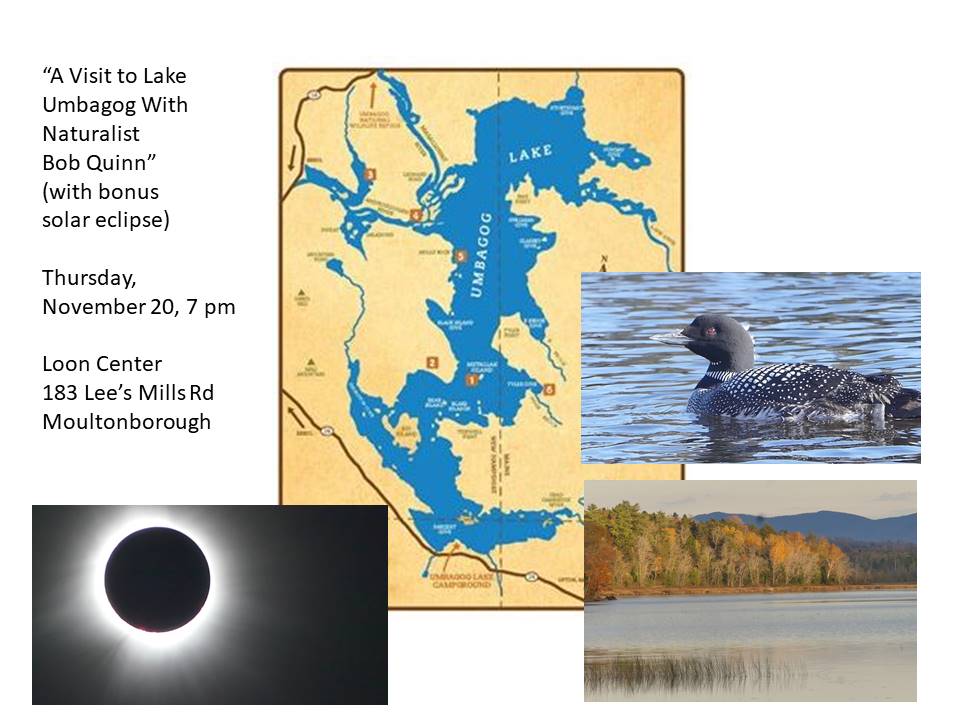
We begin with popular nature photographer Joe Callanan’s program on Otters on Thursday, September 18 at 7 p.m. at the Loon Center. On October 16, old friend Bob Quinn joins us with a program on “The Rock of Gibraltar, Southern Spain’s Migration Hotspot,” and on November 20, Bob and Dana Fox will be our speakers, topic to be decided.
If you wish to donate to the Birdathon/Bloomathon (see post below) to support the Loon Preservation Committee and the Lakes Region Chapter of New Hampshire Audubon, you may send your donation to the Loon Center at PO Box 604, Moultonborough, NH 03254. Please indicate that your donation is for the Birdathon, and make checks payable to the Loon Preservation Committee.
The Lakes Region Chapter of NH Audubon will host a chapter field trip at the Markus Sanctuary, adjacent to the Loon Center at 183 Lee’s Mills Road in Moultonborough on Saturday, May 17, at 7 a.m., returning to the parking lot at about 9 a.m., where there will be coffee and donuts courtesy of the Loon Preservation Committee.
The Birdathon/Bloomathon is a long-standing tradition for the Lakes Region Chapter, and serves as a fundraiser for both the Chapter and the Loon Preservation Committee. Originally the Chapter asked its members for pledges per species of bird or wildflower seen by an expert team in Tamworth and surrounding towns on one “Big Day” in the field, but now many donors just send an amount that they feel comfortable with. Either way, 80 percent of the proceeds support LPC, and 20 percent goes to the Chapter to pay for monthly nature programs at the Loon Center in September, October, November, January, February, March and April.
This year we have changed the format to being a Chapter field trip at the Markus Sanctuary in Moultonborough, and there is no cost to attend. However, donations will be gratefully accepted. Meet at the Loon Center at 7 a.m. and trip leaders Tiffany Grade and Jane Rice will lead the group on a walk around the Markus trails. The Loon Nest Trail is 1.7 miles with no elevation gain, and takes about an hour to walk, but we hope to see lots of migratory birds and spring wildflowers, so we plan on two hours total. According to eBird, there have been 113 total species seen at the sanctuary, so let’s see how many we can find! There is no list of blooms, so we hope to create one.
Dress for the weather and bring insect repellant or a head net in case of black flies. For more information, you may call the Loon Center at 603-476-5666.
Please note that this program is on Thursday, January 9, which is the second Thursday of the month. Lakes Region Chapter programs are usually on the third Thursday, and we don’t want you to miss it!




 Lakes Region Audubon